
Most 11+ preparation looks the same: a practice paper, a pencil, a timer, and a child who would rather be anywhere else.
Papers matter, and nearer the exam they matter a lot. But a lot of what the 11+ actually tests (quick mental arithmetic, a wide vocabulary, knowing what words like factor and prime mean without thinking) is built through repetition. Repetition is exactly what games are good at, and it doesn't have to happen at a desk.
This post is a collection of games we'd genuinely recommend. Most need nothing more than a pack of cards, some dice or a car journey.
Do 11+ games actually help?
Yes, if used correctly!
Games are good at three jobs. First, they make practice frequent: five minutes of a game over breakfast, most days, beats one longer session on a Sunday. That spacing is a big part of why topics stick, which I've written about in why children forget 11+ topics they learned months ago. Second, they make recall low-stakes: a child pulling a synonym out of their head during a game is doing the same mental work as answering a question on a paper, without the pressure. Third, they keep 11+ preparation from becoming something your child dreads, which matters more than it sounds if sessions have started ending in arguments.
What games won't do is teach exam technique. Pacing a paper, reading questions carefully under time pressure and checking answers are separate skills, and they need practice in exam conditions. More on that at the end.
English and vocabulary games
1. Synonym tennis
One person says a word. The other has to reply with a synonym. Back and forth until someone stalls or repeats a word.
big → large → huge → enormous → vast → immense → colossal → …
What it trains: synonyms, which turn up constantly in 11+ English and verbal reasoning questions. It also shows you, very quickly, where your child's vocabulary runs out.
Make it harder: allow the server to call "switch!" at any point, after which the next word has to be an antonym. Or restrict the rally to a theme, like words for happy or words for walking.
2. Describe it without saying it
Write some vocabulary words on scraps of paper. One player picks a word and describes it without saying the word itself. The others guess.
What it trains: this is about the depth of vocabulary rather than the breadth. A child who can recognise reluctant in a multiple-choice list may not be able to explain it. Having to describe a word forces them to actually know what it means.
Tip: use words your child has met recently but isn't confident with. Mix in a few they know well so that every round isn't a struggle.
3. Missing word
Read a sentence aloud with one word left out, and ask your child to fill the gap. Books you're already reading together work well.
The explorers were exhausted, but they were ______ to turn back before reaching the summit.
What it trains: cloze questions (fill in the missing word) appear in many 11+ English papers. It also trains reading for meaning; talking about why one word fits better than another is where most of the learning happens.
4. Boggle, Bananagrams and Scrabble
The classic word games are worth having in the house. They're good for spelling and for noticing how words are built from prefixes, suffixes and roots.
The honest caveat: these games reward finding words more than understanding them. A child can play quay without knowing what it is. One easy house rule fixes this: any word you play, you have to be able to define or use in a sentence, or it doesn't score.
5. The alphabet chain
Pick a category (animals, adjectives, verbs, things in a kitchen) and take turns naming something beginning with each letter of the alphabet in order.
What it trains: quick retrieval, and word classes if you choose categories like adjectives or verbs. Knowing the difference between a noun, verb, adjective and adverb comes up in 11+ English grammar questions, and this is a painless way to practise it.
6. Number plate words
This one's something I've played with my Dad. Take the last three letters from a standard license plate and try to think of words that contain those letters in that order. For instance, if you see 'SMR', you might think of 'SIMILAR'. Sometimes, letter combinations can be pretty tricky or too easy, so make sure to bend the rules to the right level of challenge.
What it trains: word recall and spelling.
Maths games
7. Countdown numbers
Pick six numbers (a mix of small ones like 1–10 and one or two big ones like 25, 50, 75, 100) and a target number. Using any of the six numbers once each, and any of the four operations, get as close to the target as you can.
Numbers: 25, 4, 7, 3, 2, 8. Target: 97.
One route: 25 × 4 = 100, then 100 − 3 = 97.
What it trains: flexible mental arithmetic, and the habit of working backwards from a target, which is exactly the move that helps on multi-step word problems. A child who thinks "97 is 3 less than 100, can I make 100?" is thinking the right way.
8. Multiplication war
A pack of cards with the picture cards removed. Each player flips two cards and multiplies them. The higher product wins all four cards.
What it trains: times tables at speed, with a natural pressure to be fast and accurate.
Make it harder: flip three cards (or more!) instead.
9. Guess my number
Think of a number between 1 and 100. Your child asks yes-or-no questions to find it, but only questions about the number's properties:
"Is it even?" "Is it a multiple of 3?" "Is it a square number?" "Is it prime?" "Is it a factor of 60?"
What it trains: vocabulary related to numbers: multiples, factors, primes, square and cube numbers. 11+ questions often hinge on knowing these words instantly, and it's surprisingly common for children to half-know them. This game makes the gaps obvious and fixes them quickly.
Swap roles: it's just as useful for your child to be the one answering. They have to check each property of their own number, which is the harder skill.
10. Shut the box
A traditional dice game. Tiles numbered 1 to 9 start open. Roll two dice, and close any tiles that add up to the total. Keep going until you can't close tiles that make your roll. Your score is what's left open, and lowest wins.
What it trains: number bonds and quick addition. It's gentle, so it suits younger children or a quick warm-up rather than serious stretch. You can buy a wooden box, or just write 1–9 on scraps of paper.
11. The shopping estimate
At the supermarket, ask your child to keep a rough running total of what's in the trolley and predict the bill before you get to the till.
What it trains: rounding, estimation and money, all of which come up in 11+ word problems. It also gives them practice at checking whether an answer is sensible, which is the habit behind a lot of silly mistakes.
Online 11+ games
There are also apps and websites that turn 11+ practice into a game. If you're weighing them up, a few questions are worth asking:
What to look for in an 11+ game or app
-
Is the content actually 11+ content? Plenty of maths and spelling apps are good, but pitched at general primary school level. The 11+ goes further.
-
Does it explain wrong answers? A game that just says "wrong" and moves on wastes the most useful moment in practice.
-
Does it reward getting things right, or just playing? Some apps hand out rewards for time spent, which can mean lots of screen time and not much learning.
-
Can you see what your child is actually struggling with? You want to know whether it's fractions or vocabulary, not just a points total.
Where 11+ Heroes fits
This is what we built, so take my view with that in mind.
11+ Heroes is an 11+ maths and English platform built as a video game. Exercises are fought as Expeditions against monsters: a correct answer lands the blow, and a wrong one comes with a worked solution explaining why. Academic progress earns XP that makes your child's Hero stronger, and each topic they improve on unlocks more of the world map. When they're ready, full mock exams test them under timed conditions, with in-game rewards as a motivator.
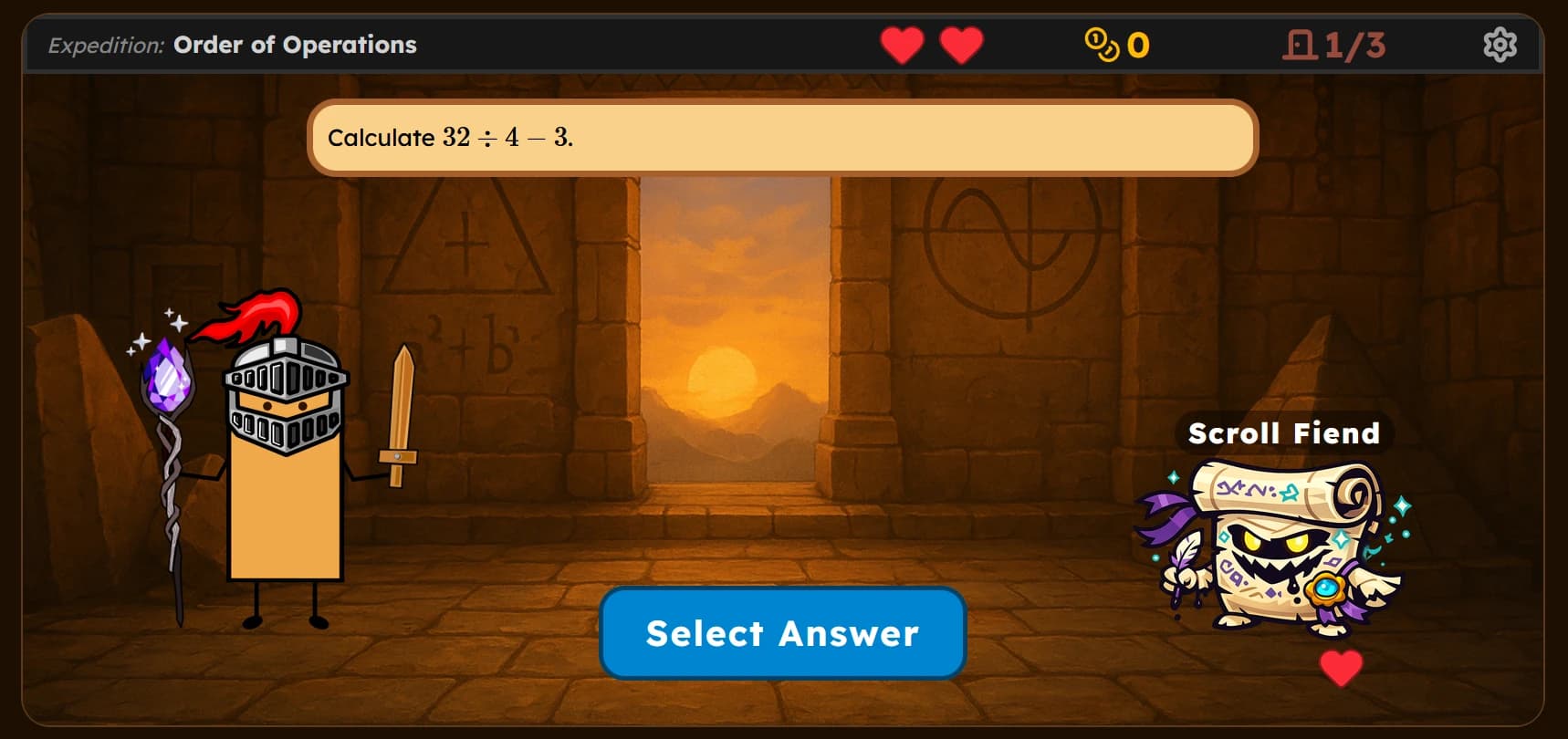
We built it this way because the games above work well for single skills, but there are a lot of skills in the 11+. It's hard to cover all of them through board games and car journeys alone. We wanted the structure of a full preparation course, with the reason to come back tomorrow that a good game has.
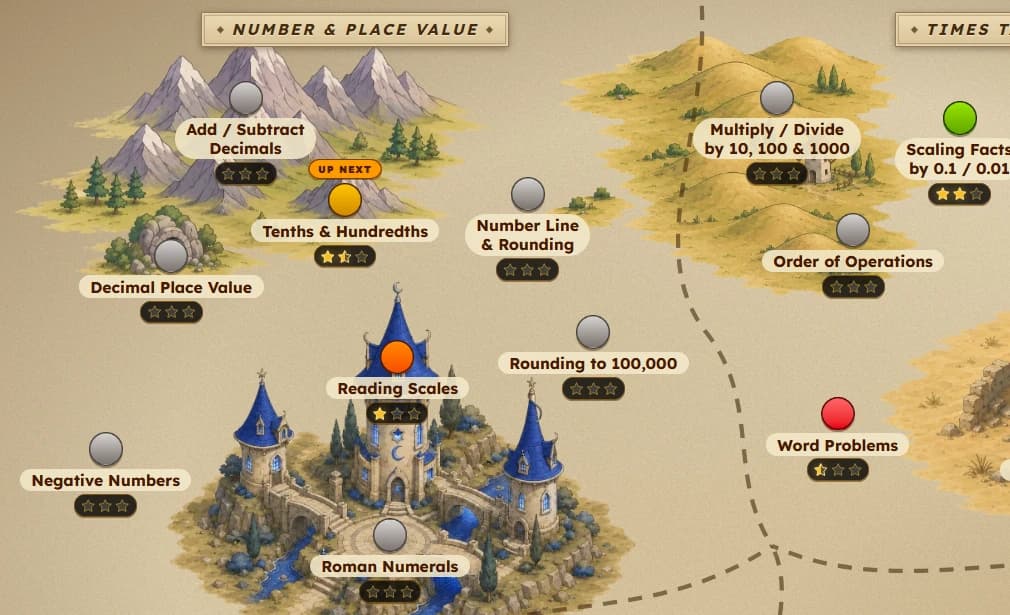
You can start for free — no payment details needed, just an account so your child's progress saves. Click here to get started.
Frequently asked questions
What age should my child start 11+ games?
Most of the games above work from Year 3 or Year 4, well before formal 11+ preparation usually starts. Starting early with games is low-risk: the vocabulary and number fluency they build is useful whether or not your child ends up sitting the exam.
How often should we play?
Short and frequent beats long and occasional. Five or ten minutes most days will do more than an odd hour at the weekend.
My child refuses to do any 11+ work. Will games help?
They can, because a game doesn't feel like 11+ work. But if refusal has become a pattern, it's usually worth understanding what's behind it first. I've written about what refusal usually means and what helps.